
 Facebook
 X
X
 Pinterest
 Copy Link
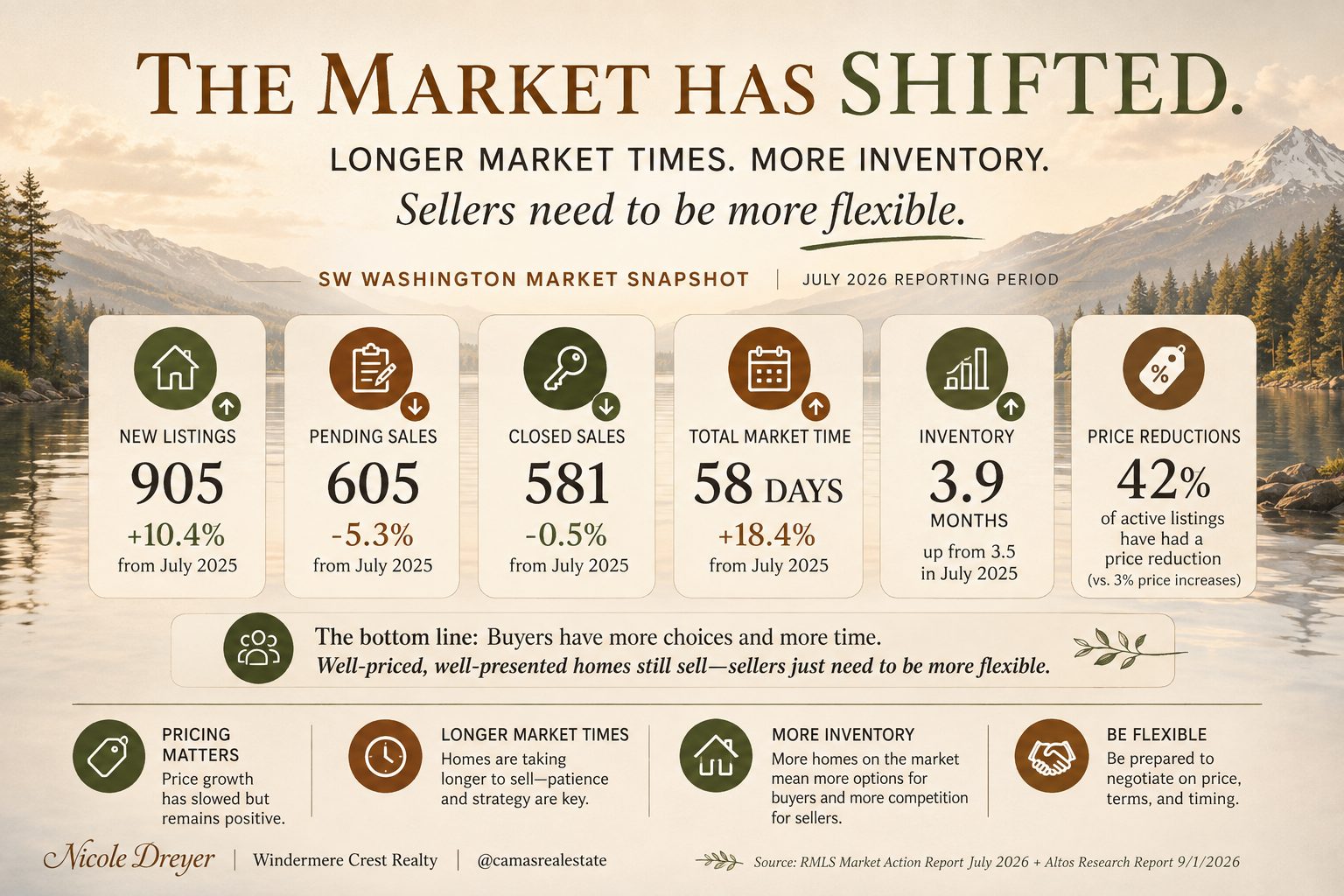
As we wrap up the summer of 2026, the Southwest Washington real estate market is giving us a pretty clear message: the market has shifted.
This isn’t the same fast-moving market we saw a few years ago, where well-priced homes could generate multiple offers almost immediately. Buyers have more choices, homes are taking longer to sell, and sellers are having to be more flexible.
That doesn’t mean the market is bad. It means the market is becoming more balanced—and the strategy for selling a home needs to change with it.
Homes Are Taking Longer to Sell
The July 2026 RMLS Market Action Report shows total market time in Southwest Washington at 58 days, up from 49 days in July 2025—a year-over-year increase of 18.4%. Inventory also increased to 3.9 months, compared with 3.5 months a year ago.
And the trend is continuing into September.
The current Clark County data from Altos Research shows a median list price of $667,500, with an average of 98 days on market and a median of 56 days. Inventory has climbed to 1,690 homes, while the Market Action Index has eased from 36 last month to 35 this week.
Perhaps one of the clearest signs that buyers are gaining some negotiating power: 49% of current Clark County listings have had a price reduction, compared with only 3% showing a price increase.
Buyers Have More Choices
More inventory changes the experience for buyers.
In July, Southwest Washington saw 905 new listings, up 10.4% from July 2025. At the same time, pending sales were down 5.3% year over year, and closed sales were down slightly.
That combination matters.
There are more homes coming onto the market, but buyers aren’t necessarily moving at the same pace. Buyers can take their time, compare properties, negotiate terms and wait for the right home rather than feeling like they have to make an immediate decision.
For sellers, that means simply putting a home on the market and waiting for the buyer to appear is no longer the strategy it once was.
Sellers Need to Be More Flexible
This is probably the biggest change I’m seeing as we move toward fall.
Flexibility matters.
That can mean being realistic about the initial list price, responding to market feedback, being willing to negotiate on price or terms, and understanding that a home may take several weeks—or longer—to find the right buyer.
The first few weeks on the market are especially important. Buyers are paying attention to new listings, and if a home is priced too aggressively compared with the competition, it can quickly become one of the properties that buyers skip over.
Once a home has been sitting for a while, a seller may find themselves having to make a larger adjustment than they would have needed to make if they had priced strategically from the beginning.
Pricing Still Matters—A Lot
The good news is that this isn’t a story about prices falling across the board.
Through July, the Southwest Washington median sale price was $555,600, up 1.0% from the same period in 2025. The average sale price was $636,000, up 1.6%.
So we’re not looking at a collapsing market.
We’re looking at a market where price growth has slowed while buyers have gained more choices and more time.
That’s an important distinction.
A well-priced, well-presented home can still attract attention and sell successfully. But homes that are overpriced or don’t show well are more likely to sit, require a price adjustment, or become increasingly difficult to move.
What Should Sellers Do Now?
If you’re thinking about selling this fall, I would approach the market differently than I would have a few years ago.
Price strategically from the beginning.
Don’t rely on what your neighbor’s house sold for six months ago. Look at the current competition and what buyers can choose from today.
Prepare the home before going on the market.
With buyers having more options, presentation matters. Good photography, a clean and uncluttered home, thoughtful preparation and strong curb appeal can make a real difference.
Pay attention to feedback.
If buyers consistently aren’t responding to the price, don’t ignore the signal. The market is giving you information.
Be prepared to negotiate.
Price isn’t the only consideration. Closing costs, repairs, timing, contingencies and other terms can all become part of the negotiation.
Don’t panic if your home doesn’t sell in the first week.
Longer market times are becoming more normal. The goal is not necessarily to sell in three days. The goal is to position the home correctly and create the strongest possible opportunity to get it sold.
The Bottom Line
The Southwest Washington real estate market hasn’t stopped moving. It has changed.
We’re seeing more inventory, longer market times and buyers who have more room to negotiate. At the same time, home values have remained relatively stable, with modest price growth continuing through July.
For sellers, the message is simple: expectations and strategy need to adjust.
The sellers who recognize the shift, price appropriately, present their homes well and remain flexible are going to be in a much stronger position than those who approach today’s market as though it were still the market of a few years ago.
And for buyers, this shift creates opportunities that weren’t as readily available in a more competitive market. More choices and more time can mean the ability to make a thoughtful decision rather than feeling pressured to act immediately.
As we head into fall, I’m watching inventory, market time, pending sales and pricing very closely. Those numbers will tell us whether this is simply a more normal, balanced market—or the beginning of a more significant change.
For now, one thing is clear: the market has shifted, and both buyers and sellers need to shift with it.
